
Essential Fatty Acids - How Essential Are They Really?




Learn what each one does.
 Essential fatty acids or EFAs for short, are basically fatty acids that your body can’t make on its own. So you have to obtain these fatty acids from your diet. There are two of them: linolenic acid (omega-3) and linoleic acid (omega-6). We need to get these fatty acids from our diet because they are needed to make other specialised fatty acids as you will see in the infographic below. All the cells and tissues in your body need both omega-3 and omega-6 fatty acids to function optimally.
Take a look at the tables below for the members in the omega-3 and omega-6 families:
Essential fatty acids or EFAs for short, are basically fatty acids that your body can’t make on its own. So you have to obtain these fatty acids from your diet. There are two of them: linolenic acid (omega-3) and linoleic acid (omega-6). We need to get these fatty acids from our diet because they are needed to make other specialised fatty acids as you will see in the infographic below. All the cells and tissues in your body need both omega-3 and omega-6 fatty acids to function optimally.
Take a look at the tables below for the members in the omega-3 and omega-6 families:
| Type of Omega-3 Fatty Acid | What are they for? | Primarily found in... |
ALA (alpha-linolenic acid)
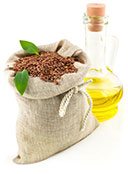 |
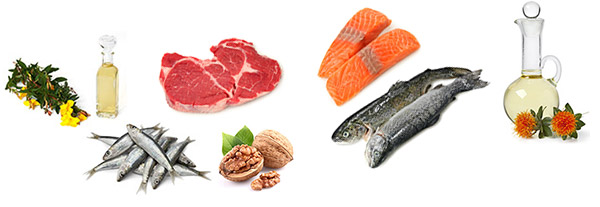
Primarily converted to docosahexaenoic acid (DHA) & eicosapentaenoic acid (EPA) EPA and DHA reduce inflammation in your body and can help to prevent chronic diseases like heart disease and arthritis. Both are also required for your brain’s development and your body’s normal growth. Note: Your body has a limited ability to convert ALA to DHA and EPA. So to get the maximum health benefits take DHA and EPA instead. | Seeds: e.g. flax, chia & hemp seeds Plant oils: e.g. flax (linseed), chia, hemp, soybean & walnuts oils Nuts: e.g. walnuts Legumes: e.g. mung beans & soybeans Green vegetables: e.g. brussel sprouts, kale & spinachNote: Getting enough omega-3’s can be tricky because most plant oils are full of omega-6’s with only small levels of omega-3’s. |
DHA (docosahexaenoic acid)EPA (eicosapentaenoic acid)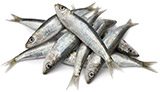 |
Their benefits are mentioned above. Unlike ALA, both DHA and EPA can be readily utilised by our cells without any prior conversion. | Oily fish such as:
Salmon, sardines, tuna, herring, trout, mackerel, anchovies
Green-lipped mussels
Fish oils: e.g. cod liver oil
Are you a vegan? Not to worry. Certain types of algae are rich in DHA and EPA. It’s actually where fish get theirs from. Plus, you don’t have to worry about mercury or other ocean contaminants. |
LA (linoleic acids)
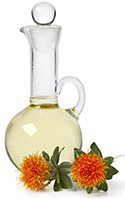 |
Important for the maintenance of normal metabolism, healthy skin, strong bones and a healthy reproductive system. It also supports normal development and growth of your brain. | Vegetable oils: e.g. soybean, safflower, sesame, corn, canola, rice bran, walnut & sunflower oils Seeds: e.g. sesame & sunflower seeds Nuts: e.g. walnuts, cashews & pecans Note: A regular western diet is full of omega-6’s so no need to take any extra. |
AA (arachidonic acid)
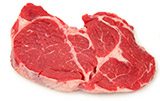 |
Mediates inflammation | Omega-6 is converted to AA by the body so the sources are the same as above. AA can also be found in meat. |
GLA (Gamma Linoleic Acid)
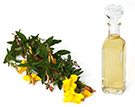 |
This omega-6 fatty acid is one of the neglected ones. It actually has inherent anti-inflammatory properties. | Plant oils: e.g. borage, evening primrose & blackcurrant seed oils |
| Copyright © Return2Health Limited. All Rights Reserved. | ||
Remember the Ratio!
Did you know that it’s important to consume omega-3 and omega-6 fatty acids in the right ratio? That’s right. Don’t freak out. You don’t need to be a math whiz or have a calculator to accomplish this. Its really very easy because its a range. The ratio of omega-6’s to omega-3’s should be from 1:1 to 4:1. Getting too much omega-6’s is easy when you follow the standard Western diet day in and day out. Specifically its the over consumption of seed oils, abundant in processed foods, that are the primary culprits. In fact a ratio of 4:1 was found to be linked to a 70% reduction in total mortality with the secondary prevention of heart disease. However the standard western diet can often produce ratios as high as 15:1!
As you can see from our omega-6 table above, the common vegetables oils are loaded with omega-6 and they’re in everything!
Getting too much omega-6’s is easy when you follow the standard Western diet day in and day out. Specifically its the over consumption of seed oils, abundant in processed foods, that are the primary culprits. In fact a ratio of 4:1 was found to be linked to a 70% reduction in total mortality with the secondary prevention of heart disease. However the standard western diet can often produce ratios as high as 15:1!
As you can see from our omega-6 table above, the common vegetables oils are loaded with omega-6 and they’re in everything!
What really happens when the ratio isn’t followed?
When your consumption of omega-6’s is much higher than your omega-3’s (you ruined the ratio), you’re setting the stage for an army of diseases. You see, when this happens your omega-6’s compete with your omega-3’s and prevent them from performing their functions properly. High levels of omega-6 also promote oxidation of the ‘bad’ cholesterol and cause platelets to become clumped. It also disrupts the composition of the phospholipids of your cell membranes. All of which are bad news for your health!
This can lead to you developing conditions like autoimmune diseases, cancers, cardiovascular diseases and other inflammatory diseases. This is because you’re putting your body into a pro-inflammatory mode. Inflammation is bad my friend…
Additionally, a high omega-6 to omega-3 ratio can also lead to a host of mental disorders like bipolar disorder, schizophrenia and depression.
High levels of omega-6 also promote oxidation of the ‘bad’ cholesterol and cause platelets to become clumped. It also disrupts the composition of the phospholipids of your cell membranes. All of which are bad news for your health!
This can lead to you developing conditions like autoimmune diseases, cancers, cardiovascular diseases and other inflammatory diseases. This is because you’re putting your body into a pro-inflammatory mode. Inflammation is bad my friend…
Additionally, a high omega-6 to omega-3 ratio can also lead to a host of mental disorders like bipolar disorder, schizophrenia and depression.
 So what? ...you ask. Pro-inflammatory mode means your immune system is agitated, you activate carcinogenic (cancer promoting) genes, you clog and injure your arteries and you pretty much anger the cells lining your body cavities. All of this leads to the army of diseases mentioned above…
 So you should try to reverse the ratio by reducing your omega-6 intake and increasing your omega-3’s to protect your mental and physical health and well-being.
Remember, we need to obtain essential fatty acids from our diet because our bodies can’t make them. By following the correct ratio you can experience the best health benefits of omega-3 and omega-6 fatty acids. There is plenty of evidence available regarding the positive benefits of consuming these fatty acids.
Benefits you may notice when you get the right ratio of omega-6 to omega-3:
So you should try to reverse the ratio by reducing your omega-6 intake and increasing your omega-3’s to protect your mental and physical health and well-being.
Remember, we need to obtain essential fatty acids from our diet because our bodies can’t make them. By following the correct ratio you can experience the best health benefits of omega-3 and omega-6 fatty acids. There is plenty of evidence available regarding the positive benefits of consuming these fatty acids.
Benefits you may notice when you get the right ratio of omega-6 to omega-3:
- Improvements in PMS, joint pain and inflammatory bowel conditions.
- Reduced chance of having a heart attack or stroke.
Related Articles



References
- https://www.ncbi.nlm.nih.gov/pubmed/12442909
- https://www.ncbi.nlm.nih.gov/pubmed/17045449
- http://www.sciencedirect.com/science/article/pii/S0924977X03000324
- https://www.ncbi.nlm.nih.gov/pubmed/15907142
- https://journals.lww.com/psychosomaticmedicine/Abstract/2007/04000/Depressive_Symptoms,_omega_6_omega_3_Fatty_Acids,.1.aspx
- Siguel, Edward N. Essential Fatty Acids in Health and Disease: Using the Essential Fats Omega-3 and Omega-6 to Improve Your Health, Lower Your Cholesterol and Prevent Cardiovascular Disease. Brookline, Mass.: Nutrek Inc., Nutrek Press, ©1994.
- Ferrier, Denise R. Biochemistry. 6th ed. Lippincott's Illustrated Reviews. Philadelphia: Wolters Kluwer Health/Lippincott Williams & Wilkins, ©2014.
- Modern Nutrition in Health and Disease. 11th ed. Philadelphia: Wolters Kluwer Health/Lippincott Williams & Wilkins, ©2014.
×
![Image Modal]()
This content will be overwritten when the modal opens
This form is protected by reCAPTCHA - the Google Privacy Policy and Terms of Service apply.