
Your Nervous System - Part 1





Learn what it does for you.

[Click on the image to Enlarge]
A sneak peek at your body’s own CPU (Central Processing Unit)
What is your nervous system all about? What does it do?
Your nervous system controls everything you do; your breathing, thinking, feeling, and moving. It’s primarily divided into two connected parts; your central nervous system (your brain and spinal cord) and your peripheral nervous system (the rest of the nerves and neurons in your body). If you compare your nervous system to a computer, it would be very much like the CPU (central processing unit).
Your brain represents the command centre. Every complex thought, memory, and emotion you might have are processed here. On the other hand, your spinal cord functions pretty much like a main highway which conveys signals towards and away from your brain. Your brain would not be able to work if you injured your spinal cord and vice versa.
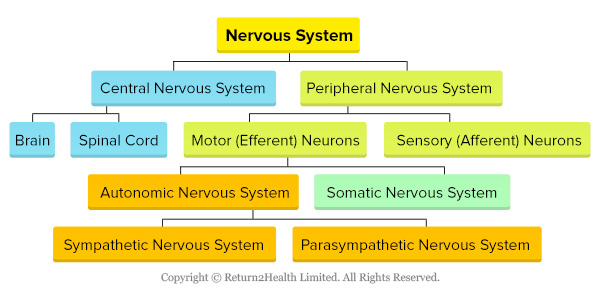
Your peripheral nervous system allows you to get in touch with the external environment. It has two branching arms which make receiving and conveying signals easier. They are the motor and sensory groups of neurons.
For example, let’s say you want to hike the Milford Track in New Zealand or the Overland Track in Tasmania, Australia. Your motor neurons are in charge of making sure that your skeletal muscles move efficiently for your hike. To be more specific, it’s your somatic nervous system (see diagram above) which commands your muscles to contract and relax.
 After hiking for some time, when you feel exhausted, hot and thirsty, your sensory neurons sense these things and relay the messages to your peripheral nervous system. Your peripheral nervous system in turn talks to your brain and tells you to slow down (or stop) and drink water.
 Your autonomic nervous system is a special division of your motor neurons and includes the sympathetic and parasympathetic nervous systems. When you’ve eaten those bacon and eggs for, it's your parasympathetic nervous system that controls your digestion and relaxation processes afterwards. It assumes a driver’s seat whenever you do something which relaxes you (like eating or snoozing).
Meanwhile, your sympathetic nervous system came into play this morning when you fled (flight or fight) from your neighbour’s dog while you were secretly viewing today’s headlines on their paper.
 All the parts of your nervous system function together at the same time to give your body the information it needs to react to whatever is happening around and inside you. It’s your responsibility to take care of your nervous system and supply it with the nutrients it needs to function optimally.
 Here are the final two parts to this article:
Your Nervous System Part 2: Common clues and medical conditions that indicate a troubled nervous system Your Nervous System Part 3: Secrets for a healthy nervous system
Related Articles


References
- Drake, R., & Vogl, W. (2014). Gray's anatomy for students (Third ed.).
- Ropper, A., & Samuels, M. (2014). Adams and Victor's principles of neurology (Tenth ed.).
- http://www.betterhealth.vic.gov.au/bhcv2/bhcarticles.nsf/pages/Nervous_system
- https://www.news-medical.net/health/What-is-the-Nervous-System.aspx
×
![Image Modal]()
This content will be overwritten when the modal opens
This form is protected by reCAPTCHA - the Google Privacy Policy and Terms of Service apply.